
Paper Tableware RFQs: Separate GSM and Item Weight
GSM describes paper mass per unit area; an item weight in grams describes a different quantity. In a tableware RFQ, keep the declared paper grammage and finished-piece weight in separate fields for each component. Ask the supplier to confirm the material scope and weighing basis rather than treating the two figures as interchangeable.
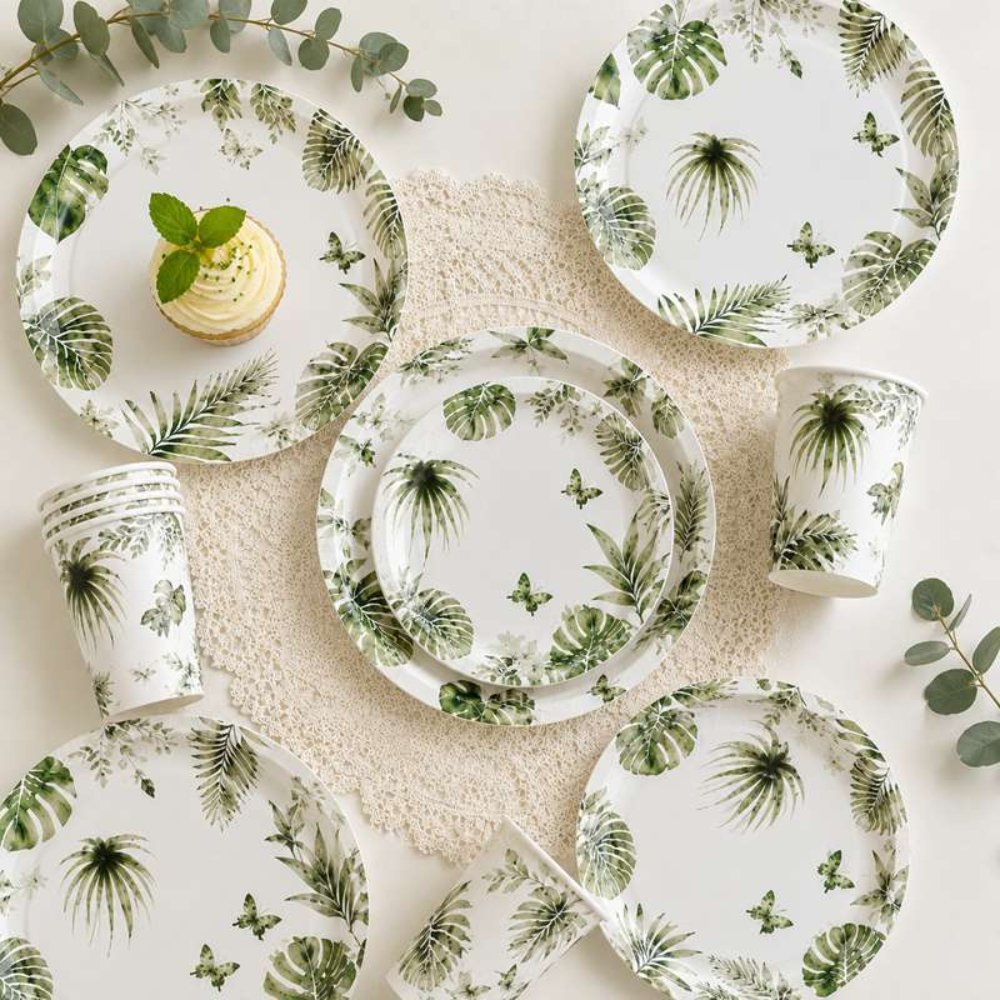
The official overhead product view identifies the components whose paper and item-weight fields need separate rows. It is not a weighing, grammage or material-performance test.
Read the material and item-weight fields separately
Miaoteng Paper’s Monstera Leaf Party Set listing gives both paper grammage and component weights. Those entries support different purchasing questions. A buyer sourcing wholesale monstera leaf party sets should keep the proposed paper specification separate from the mass of one finished plate, cup or napkin.
GSM means grams per square metre: paper mass for a defined area. A finished-item weight in grams is a different quantity. Writing both values in one general “paper weight” field can turn a useful specification into an ambiguous comparison. Name the component and quantity type before asking the supplier to confirm the numbers.
Preserve the component-specific catalogue entries
The following table records the inspected page’s declarations. These are supplier-published starting points for an enquiry, not measurements performed for this article. Ask the supplier to confirm which offered component and material each entry represents.
Component
Published paper description
Published item weight
7-inch plate
300 gsm white cardboard
8 g
9-inch plate
300 gsm white cardboard
12.5 g
Paper cup
210 gsm cup paper
5 g
Paper napkin
18 gsm wood pulp paper
5 g
The two plate entries name the same paper grammage and different item weights. The cup and napkin name different paper descriptions while sharing a 5 g entry. These examples show why one field cannot replace the other. Shared item mass does not establish identical materials, and shared GSM does not describe an identical finished article.
Official Monstera catalogue group supplies a visual component reference. Displayed quantities and extra items do not establish the actual quoted pack contents.
Ask what the paper declaration covers
For each component, ask the supplier to identify the paper material and explain the scope of its GSM declaration. Keep the answer tied to the actual proposed plate, cup or napkin. If a component uses more than one separately described material, ask for the relevant descriptions instead of assuming that one number defines every part.
For a napkin, ask how the stated paper specification relates to the supplied construction. Do not infer a layer count from 18 gsm or from the listed item mass. For a cup or plate, keep any separately requested surface or material information in its own response field. The paper description alone does not answer every question about the completed product.
Name the exact component and proposed version.
Keep paper grammage in a field with its area-based unit.
Ask which material or construction scope the declaration covers.
Retain any supplier document with its actual represented material.
Define the finished-item weighing basis
Ask whether the published gram figure refers to one complete component and what it includes. Keep packaging outside the field unless the supplier expressly defines a packed-item basis. If the buyer needs both net item mass and packed mass, request them separately with their units and included contents.
When a sample-weight check is required, agree the item condition and review method before using it for acceptance. Record which component was weighed and retain the actual observation. A supplier’s catalogue number and a buyer’s sample observation should remain distinguishable, especially when the proposed material or construction changes during quotation.
Another gallery scene shows related tableware in use as styling. Food and props do not establish food-contact suitability, paper composition or a completed use test.
Avoid turning weight into an unsupported property
GSM is not a thickness value or a direct statement of carrying performance. Item mass likewise does not establish serving capacity, leak resistance or another use result. If those properties matter, identify the requirement separately and ask for suitable product-specific information rather than treating a larger weight figure as an automatic approval.
Also avoid deriving a missing GSM value from a finished plate’s mass and nominal size. That shortcut assumes material area and construction details the catalogue does not define for the calculation. Request the supplier’s declared paper specification and supporting scope instead of creating a precise-looking figure from incomplete inputs.
Compare quotations on matching fields
Put the same component rows in each enquiry and request the paper description, GSM scope and finished-item mass as distinct answers. If an alternative changes the paper proposal or construction, keep that change visible beside the price. This helps purchasing compare actual proposals without allowing a single familiar gram figure to conceal a different material description.
Retain the confirmed material response and any sample observations with the quotation version. For a later order, ask whether the same component specification is proposed before reusing the earlier values. Send the component table and open weight-basis questions through the Miaoteng contact page.
Paper tableware weight questions
Is 300 gsm the weight of one plate?
It is an area-based paper description. The page lists finished plate weights separately. Ask the supplier to confirm both fields for the offered component.
Do two 5 g entries identify the same construction?
No. The cup and napkin entries describe different components and paper materials. Keep their identities and specification scopes separate.
Does GSM replace a performance evaluation?
No. Define the required use-related property separately and request relevant evidence. Keep grammage and sample mass within the actual scope of those fields.
Paper GrammageTableware SpecificationsGSM and Item Weight