
Birthday Tableware: Proof the Printed Message
For birthday tableware carrying a printed greeting, approve the exact message, letter case, line breaks and reading direction for each component. Ask the supplier to identify the corresponding artwork revision and sample. A birthday-themed product name identifies the occasion; a text proof establishes which words and arrangement the buyer has actually accepted.
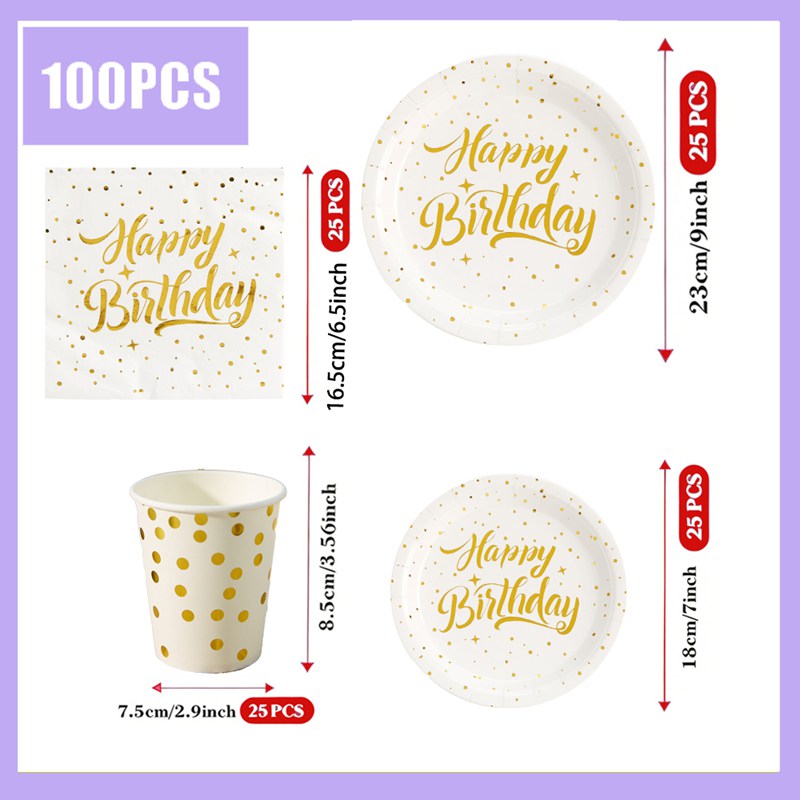
Official product overview shows “Happy Birthday” on the plates and pictured napkin, with dots on the visible cup. Annotated counts and dimensions remain catalogue context, not an accepted order specification.
Start with the words actually shown
The Gold Foil Happy Birthday Party Disposable Tableware Set listing names a white-and-gold design. Its inspected overview shows the words “Happy Birthday” on the plate faces and pictured napkin. The visible cup presentation uses gold-coloured dots. Keep this actual product link and the selected image together when requesting the text proof.
The pictured greeting has a capital H and B, with the remaining letters in lowercase. It places Happy above Birthday in a script-style arrangement. Treat those observations as the starting reference for supplier confirmation, rather than retyping a general birthday slogan and assuming its appearance is equivalent.
Create an exact written text master
Write the two words exactly as selected and record their case and line break. Keep the written text beside the supplier’s proposed visual proof. The text master answers the spelling question; the proof shows the lettering and arrangement being offered. Retain both so a correct phrase does not conceal an unintended layout change.
Ask the supplier to identify the artwork or lettering reference it proposes. If a proof changes a letter, punctuation mark, word order or line break, mark that specific difference. Keep requested edits separate from the existing catalogue wording and ask the supplier to confirm what it can actually offer.
Proof field
Decision to retain
Exact message
Spelling, letter case and punctuation
Text arrangement
Word order, line breaks and lettering reference
Reading direction
Marked top and orientation on each component
Approval identity
Component, artwork revision and matching sample
Distinct official plate close-up shows part of the Birthday lettering. Use the complete artwork to proof the whole greeting; this detail alone omits part of the message and arrangement.
Confirm which components carry the message
Ask the supplier to identify the message-bearing design separately for each plate, cup and napkin being quoted. Mark a component as carrying the greeting only when its offered artwork confirms that scope. Keep a component using dots or another decorative arrangement on its own design line.
The reviewed cup views show dots, while the overview shows the greeting on plates and a napkin. Request the complete proposed cup artwork before deciding whether a message appears elsewhere around it. A coordinated set does not require every piece to carry identical words.
Mark the intended reading direction
Ask the supplier to mark the top of each message-bearing artwork and show its orientation on the offered component. For the napkin, identify the presented panel and view being approved. For a cup, request the full proposed printed view rather than approving unseen areas from one styled photograph.
Keep orientation marks outside the intended printed message unless the supplier identifies them as part of the design. Ask for clarification when a flat artwork view and a product photograph appear differently rotated. Record the applicable component and view so the correction concerns the actual text direction.
Proof each word and letter case.
Retain the selected line breaks.
Identify the message-bearing components.
Mark the reading direction on each proof.
Official cup composition shows gold-coloured dots on the visible surfaces. It does not establish the complete wrap artwork or mean that a birthday message must appear on every component.
Approve one identified proof and sample
Request a supplier proof and identified sample corresponding to the proposed message and component arrangement. Compare the complete greeting with the written master, then review its case, line breaks and direction. Record corrections against the specific proof revision, leaving unresolved text or missing views visible.
When a corrected proof arrives, review the whole message as well as the marked correction. Keep the earlier proof and the supplier’s response together. Approval of a changed word or line should identify the complete revision being accepted, so purchasing is not relying on several disconnected correction messages.
Carry the accepted text into the quotation
An enquiry can read: “Please confirm the exact Happy Birthday message, letter case, line breaks and reading direction for each quoted component. Provide the corresponding artwork revision and sample reference, distinguishing components with the greeting from decorative-only artwork.” Send the product link through the supplier contact page.
Keep any unresolved spelling or orientation item attached to its component row. A decision on one plate should not close an unanswered question about another plate, the cup or the napkin.
Ask the quotation to cite the accepted component proof references. If another language, name or phrase is requested, keep it as a proposed change requiring a supplier response. The catalogue greeting does not itself establish available customization or an agreed revised message.
Keep the evidence boundary clear
The wording observations come from official catalogue images; no production sample was inspected or tested. The Gold Foil name and Gold Hot Stamping category are supplier labels, not independently verified process descriptions. Text approval does not establish colour matching, coating composition, food-contact suitability, durability or other performance. Keep any required evidence separate from the spelling and orientation decision.
Frequently asked questions
Does the theme name approve the exact message?
Retain the written text and an identified component proof.
Must every component carry the greeting?
Confirm each component’s actual offered artwork separately.
What should identify a corrected message?
The complete revised proof, matching sample reference and buyer decision.
birthday tablewareprinted messagetext proofartwork revision