
Printed Party Cups: Request the Seam Reference
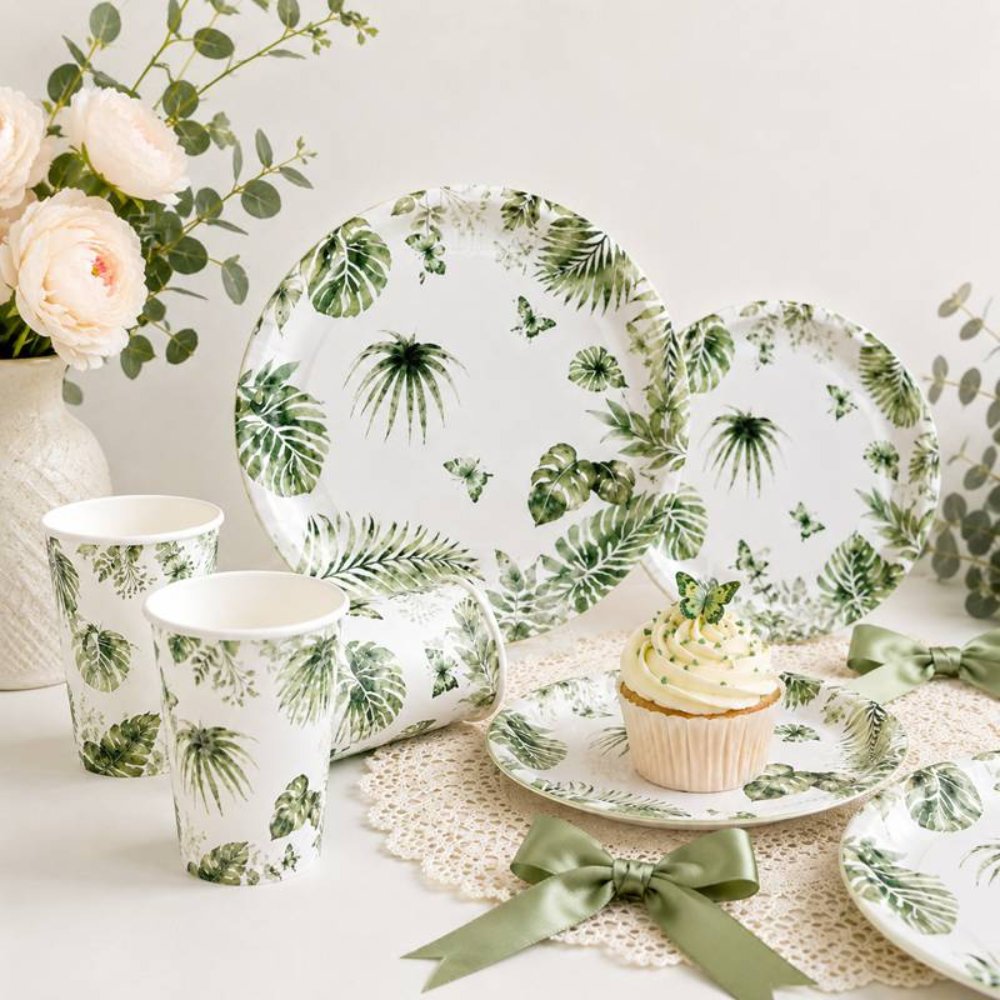
What seam information should a buyer request for printed party cups? Identify the actual cup version and ask for supplier-linked views of its side seam, bottom junction and rim. Request the construction information relevant to the proposal and define any sample review separately. A themed table scene shows an appearance reference; it does not document every joint or establish leak resistance, strength or food-contact suitability.
Official styled product reference. Cups are visible, but hidden seams and bottom joints are not documented by the scene; food, flowers and ribbon are props.
Name the cup construction question separately
Miaoteng Paper lists a paper cup within its Monstera Leaf Party Set. The product page names cup dimensions, an item weight and a cup-paper grammage. Those entries identify different specification fields. They do not describe the side seam, bottom junction or rim construction of the offered cup.
For a buyer sourcing wholesale monstera leaf party sets, the cup may need its own construction enquiry alongside the coordinated design discussion. Start with the exact cup and supplier proposal. A matching leaf theme does not demonstrate that two cups from different offers have the same physical construction.
This article concerns the supplier reference for the cup joints and rim. It is separate from identifying the printed variant, interpreting the dimension fields, comparing paper grammage or requesting the height of a nested stack. Those records can refer to the same component without replacing its construction information.
Buying field
Requested supplier response
Offered cup
Supplier reference and version of the paper cup included in the proposal.
Side seam
Identified view or drawing locating the seam and describing the actual proposed construction.
Bottom junction
Relevant inside and outside references with supplier explanation of the offered joint.
Rim
Clear view and available construction information for the upper edge.
Sample review
Identified sample, requested observations and any separately agreed evaluation.
Applicability
Confirmation that the views and information represent the quoted cup version.
Request views that locate the side seam
Ask the supplier to show where the side seam lies on the actual cup and how it relates to the printed design. Request enough context to identify the complete cup as well as the local area being discussed. A close detail with no sample reference can be difficult to connect to the commercial proposal.
Where the seam affects an appearance requirement, mark the relevant area and ask for the supplier response. Do not infer an agreed seam position, overlap dimension or print registration tolerance from one styled image. Any particular requirement should be identified and accepted as part of the proposal.
Keep the seam description separate from a claim about joining technology. The catalogue photographs do not establish a manufacturing process or the materials used in a hidden joint. Ask what construction information the supplier can provide for the actual offered version rather than naming a method from appearance alone.
Official coordinated tableware group for identifying the cup family. Props and illustrated quantities do not establish actual supplied contents.
Include the bottom junction and upper rim
Request the relevant bottom views when the joint is important to the buying brief. Ask the supplier to identify which outside and inside areas the images show. A photograph of the printed sidewall does not establish the form of the bottom junction or supply information about areas hidden from view.
For the upper rim, ask for a clear reference that represents the proposed cup. State any particular visual or dimensional question separately. Do not assign a rim thickness, curl dimension or acceptance tolerance from a perspective photograph with no agreed measurement reference.
A supplier drawing or written construction response can supplement photographs where available. Link each item to the same sample or offered version. If the supplier cannot supply a requested detail, keep that limitation visible and decide what additional sample information the buyer needs before accepting the proposal.
Separate construction observation from use evaluation
A seam or rim view can identify visible construction without proving how the cup performs in use. If the purchasing brief needs a particular use-related property, state that requirement separately and ask for suitable product-specific information and an agreed evaluation. This article does not supply a universal test method or pass threshold.
The page lists cup paper at 210 gsm and a cup item weight of 5 g. These are supplier declarations, not results measured for this article. Neither number proves joint strength, leak resistance, temperature suitability or compliance for a destination or application.
Likewise, a gallery scene containing a drink or food prop is not a completed use test. Keep the source image as a catalogue appearance reference. Request relevant evidence for the actual proposed cup where the intended use requires it, rather than treating the styling scene as an approval.
Official overhead catalogue reference. Printed appearance and visible rims do not establish a joining method, joint dimensions or use performance.
Carry the same construction reference into the order
Retain the identified cup sample, seam and junction views, rim reference and supplier explanation with the quotation. The buyer comparing offers should be able to see which information belongs to each proposal. A shared product-family name is not enough when the actual versions differ.
If a later proposal changes the cup construction, ask which views, drawings or descriptions have changed. Keep the revised sample distinct from the earlier reference. Do not silently transfer a prior appearance or construction decision to a different version merely because the leaf artwork remains similar.
For receiving handover, state which visible references were accepted and which use-related questions were handled separately. A reviewer can then record a specific observed difference and refer it to the supplier. This creates a defined component record without inventing a material composition, a manufacturing capability or a future performance guarantee.
Buyer FAQ
Does the party-set group image show the complete cup joint?
It provides catalogue context. Request identified seam and bottom views for the actual offered cup where those details matter.
Does 210 gsm define the seam construction?
No. It is a paper grammage declaration. Ask for the separate construction description applicable to the proposed component.
Can a rim dimension be estimated from the photograph?
Request an agreed measurement reference and supplier value where required. No numerical dimension is inferred here.
Do clear joint views prove leak resistance?
No. Keep visual construction information separate from any defined use requirement and supporting evaluation.
What should be retained after a cup revision?
Keep the revised sample identity, affected views, supplier response and scope of the new decision alongside the earlier history.
Identify the component on the Monstera Leaf Party Set page, request the offered cup construction references, and consult the tableware purchasing blog for related specifications.
Identify the proposed cup version.
Request located seam, bottom and rim references.
Keep construction observations distinct from use-performance evidence.
wholesale monstera leaf party setsB2B supplier sample record